


Canada Is Looking for New Food Suppliers. Are You Ready to Be Found?
Canada is one of the most accessible developed-market destinations on the planet for MENAT agri-food producers. Not because of a new free trade agreement. Not because of a government incentive program. But because of a geopolitical rupture that has fundamentally — and perhaps permanently — restructured how Canadian buyers, retailers, and consumers think about where their food comes from.
Patricia Kebbe
3/31/20264 min read
Let me say something that might surprise you: right now, in early 2026, Canada is one of the most accessible developed-market destinations on the planet for MENAT agri-food producers. Not because of a new free trade agreement. Not because of a government incentive program. But because of a geopolitical rupture that has fundamentally — and perhaps permanently — restructured how Canadian buyers, retailers, and consumers think about where their food comes from.
If you haven't been paying attention to what's happening north of the US border, you should start now.
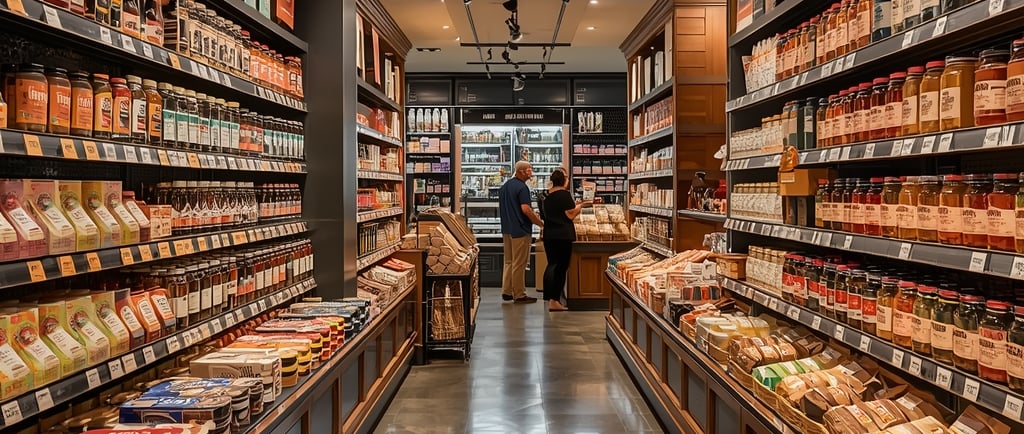
The Shelf Space Is Empty. Someone Has to Fill It.
The Canada-US trade war didn't just generate headlines. It generated a consumer movement unlike anything Canada has seen in modern history. Polling found that 91% of Canadians want Canada to rely less on the United States — a figure that would be extraordinary in any country, let alone one that shares the world's longest undefended border with its neighbor. Seventy-one percent of Canadian consumers report they will buy fewer US grocery products in 2025, with 84% citing US-imposed tariffs as their primary reason.
This isn't a protest. It's a purchasing shift. And in Quebec specifically, it went from sentiment to policy almost overnight. The government of Quebec announced that all US products would be removed from the Société des alcools du Québec website and that supplies to grocery stores, bars, and restaurants would be halted. Major retail banners — Walmart, Loblaws, Metro, Sobeys — began ordering fewer American products until the tariff environment stabilized.
The vacuum this has created on Canadian shelves is real, measurable, and still largely unfilled. Canadian domestic production cannot absorb it entirely — interprovincial trade barriers, production scale limitations, and regulatory fragmentation all constrain how quickly local suppliers can step in. That gap is an invitation. The question is who accepts it.
The Conventional Wisdom Is Wrong.
Most MENAT agri-food producers, when they think about export expansion, gravitate toward the familiar: the Gulf, Southeast Asia, the European Union. Canada barely registers as a priority market — it's perceived as too distant, too regulated, too dominated by domestic brands and US imports.
That conventional wisdom is now outdated, and clinging to it will cost you.
In February 2026, the Government of Canada launched two new Agri-Marketing Program streams, investing $75 million over five years to explicitly support diversification into high-growth, non-traditional markets — naming the Middle East among the priority regions. At the federal level, Canada's 2026–27 trade plan commits to maintaining established markets while diversifying across priority regions including the Middle East and North Africa. This is not diplomatic language. It is funded policy with application windows, matching contributions, and trade commissioner support actively deployed in MENAT markets.
In other words: the Canadian government is spending money to find you. Are you spending any effort to be found?
Quebec Is Not Just a Province. It's a Gateway.
Within Canada, Quebec deserves special attention from MENAT exporters — and not for the reasons most people assume.
Yes, Montreal is Canada's second-largest city and the commercial heart of a province of 9 million people. But what makes Quebec strategically significant for MENAT producers is its food culture, its diaspora demographics, and its distribution architecture.
Quebec hosts one of the largest Arab diaspora communities in North America, concentrated primarily in Montreal and its surrounding suburbs. This community doesn't just consume MENAT products — it imports them, distributes them, retails them, and advocates for them within the broader Quebec food ecosystem. Ethnic grocery networks in Montreal have been quietly building distribution infrastructure for Middle Eastern, North African, and Levantine products for decades. For a MENAT brand entering the Canadian market, this pre-existing infrastructure dramatically reduces the cost and complexity of market entry.
And then there is Quebec's mainstream food culture — sophisticated, origin-curious, and increasingly multicultural in its palate. Za'atar, harissa, tahini, and preserved lemons are no longer specialty items in Montreal. They are restaurant staples. Quebec's culinary media, food influencer ecosystem, and specialty retail sector are primed to receive well-positioned MENAT products not as exotic imports, but as premium, story-rich additions to an already diverse pantry.
Getting in the Room: What It Actually Takes
Here is where I want to challenge another assumption: that entering the Canadian market requires a massive investment, an established local partner, and years of regulatory navigation before your first sale.
The reality is more nuanced. Canada does have specific requirements — bilingual labeling, CFIA-compliant food safety documentation, and in many categories, halal certification from a recognized Canadian body. These are non-trivial but entirely manageable for any producer who is already exporting to regulated markets. The MENAT region's most capable food manufacturers are already operating at a standard that meets or exceeds Canadian import requirements in most categories.
What MENAT producers actually lack is not compliance readiness — it's market intelligence and the right relationships. They don't know which distributors are actively sourcing, which retail buyers are attending international trade missions, or which product categories are experiencing the sharpest substitution away from US imports right now. That information exists. It is accessible. And it is what separates the producers who move first from those who discover the opportunity two years too late.
The Window Is Open. It Won't Stay That Way Forever.
Trade disruptions create opportunities that are structural in the short term but competitive in the medium term. The shelf space that opened when US products were pulled will be filled — by domestic producers who scale up, by other international suppliers who move quickly, or by MENAT brands that decide now is the moment to act.
More than half of Canadian consumers report that they continue to avoid American products in their day-to-day purchases well beyond the initial political trigger — and when that shift persists for months rather than weeks, it becomes a lasting change in how people shop.
This is not a trend. It is a structural realignment. And for MENAT agri-food producers with the quality, the certification, and the ambition to compete in a demanding developed market, Canada — and Quebec in particular — is one of the most underexploited opportunities available today.
The room is open. The buyers are ready. The question is whether you're ready to walk in.
Interested in exploring what a Canada market entry strategy could look like for your business? Reach out to The Industrial Kingdom. We connect MENAT agri-food producers with the market intelligence, distributor networks, and on-the-ground expertise to turn opportunity into results.
CONTACT


The Industrial Kingdom
Berytech bldg., Mar Roukoz, LEBANON
Mobile: +961.3.621813
hello@theindustrialkingdom.com
ADDRESS
2026, The Industrial Kingdom Consulting Services
Phone: +961.4.533040 ext. 2426
©
valerie.zakka@theindustrialkingdom.com